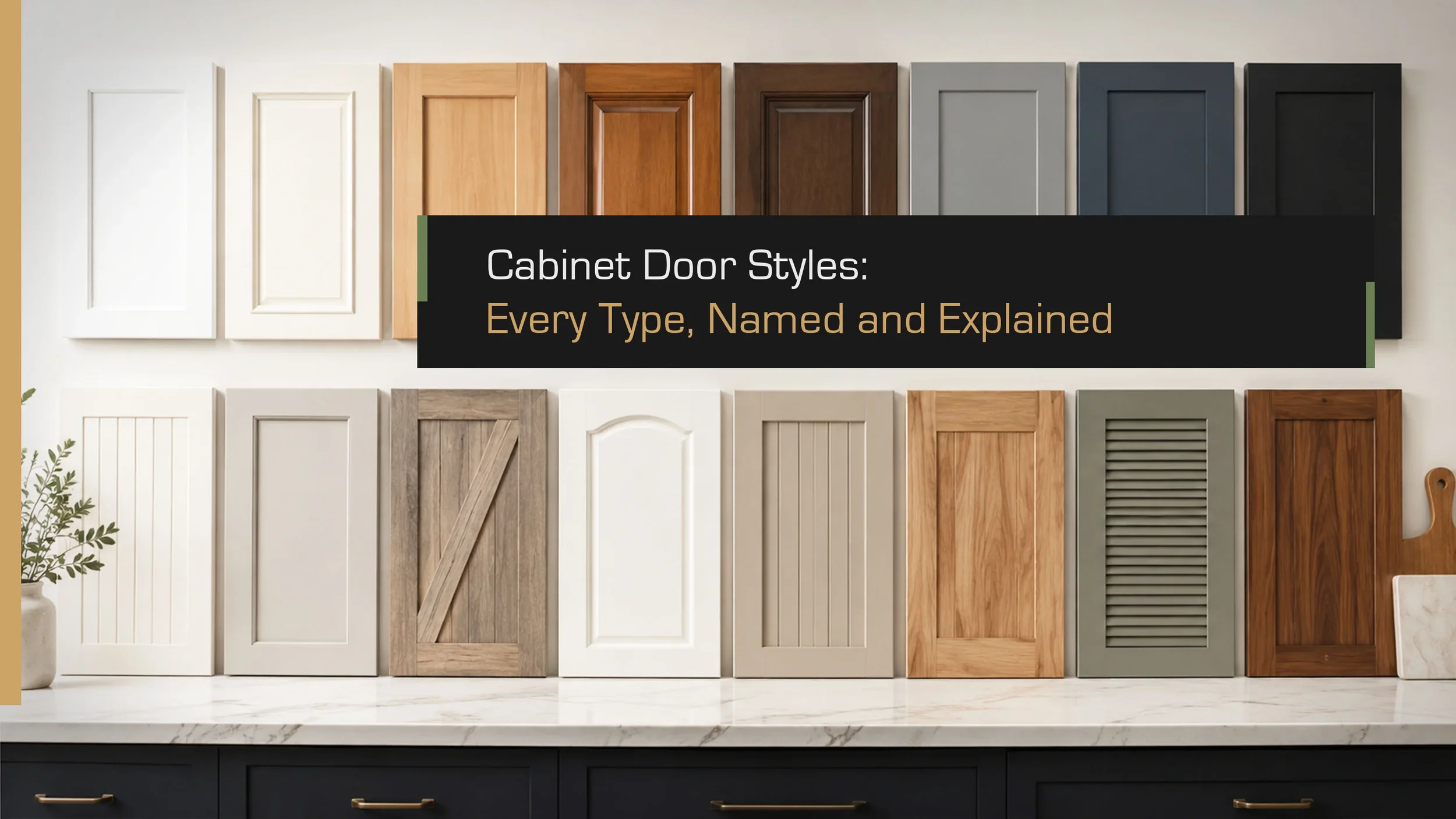
While planning a kitchen remodel, you almost immediately realize that your cabinets set the visual layout for the entire kitchen space. Cabinet doors are the single biggest visual surface in a kitchen, hence, your selection of cabinet doors becomes an important part of the design. Once you begin to explore the designs, the industry jargon such as shaker, slab, inset, full overlay can be overwhelming. This guide will try to demystify the popular cabinet door styles offering a detailed platform that will walk you through the latest cabinet types, door style, a glossary and also how you can choose the ideal door..
The most popular cabinet door styles are shaker followed by slab, raised-panel, inset, glass front and so on. While style refers to the visual design of the door face, the type or mount decides how that door sits on the cabinet box, such as an overlay or an inset structure.
Cabinet door ‘style’ vs. cabinet ‘type’ — what’s the difference?
Before diving into aesthetics, it will help to differentiate structural terminology from visual design. Property owners and remodelers frequently blend these terms which can be confusing.
Cabinet door style: This strictly refers to the aesthetic profile and design of the door itself. It depends on your selection and choice as it sets the visual foundation of the kitchen. It could be minimalistic or traditional.
Door type or mount: This indicates how the door attaches and positions upon the cabinet frame, such as overlay mount, inset mount, surface mount, or concealed mount. The type of the door also determines its mount.
Cabinet type: This describes the physical box configuration and its location on the kitchen floor plan which can be the base, wall, tall/pantry, etc.
Types of Cabinets (the box configurations)
The type of kitchen cabinetdetermines your kitchen’s capacity for storage. The construction of these cabinet structures generally fall into two categories: framed and frameless. Framed cabinets are mostly traditional American boxes with a supportive face frame and frameless cabinets are European-style boxes offering full-access interior space.
| Cabinet Type | What It's For | Good to Know |
|---|---|---|
| Base Cabinets | Floor-mounted storage that rests on the floor, supporting countertops and sinks. | Standard depth is 24 inches; they form the functional backbone of heavy-use zones. |
| Wall/Upper Cabinets | Storage cabinets fixed directly to the wall for spices, utensils and cutlery. Mostly fixed at eye level. | To maintain workspaces unobstructed, they are mostly 12–14 inches deep. |
| Tall/Pantry Cabinets | A vertical storage solution, often floor-to-ceiling, used for food and large appliances. | Normally 84 to 96 inches tall. |
| Specialty Cabinets | Personalized styles or configurations like kitchen islands and open shelves. | Important for enhancing dead corners and improving overall kitchen workflow. |
Stock cabinets are fixed in sizes and pre-built, semi-custom cabinets offer flexibility in size and finish at mid-prices, and fully custom cabinets are built to your exact choice of specifications which is the most expensive, yet, best for precise fitting.
Cabinet door styles: every popular style, explained
Here are the main types of cabinet door styles you can choose from:
Shaker
Shaker is the most widely used kitchen cabinet door style in North America. It features a five-piece construction: four flat rails and stiles forming a frame around a flat center panel. The result is clean, slightly recessed or sunken geometry with no unnecessary ornamentation. Shaker doors feel at home in transitional, farmhouse, and contemporary kitchens, making them the safest choice. They are mid-range in cost, widely available in stock and semi-custom lines, and easy to paint or stain.
Slab / Flat-Panel
A slab door is a single, uninterrupted panel with no frame, grooves, or raised detail. The look is pure and minimal: seamless from edge to edge. This style dominates in modern and contemporary kitchens where the goal is a sleek, handle-free visual. Slab doors in painted MDF are among the most affordable options on the market; solid-wood slabs cost more but offer better durability. Maintenance is the easy, one flat surface which does not allow for grease.
Raised Panel
Raised panel doors have a center panel that sits above the plane of the surrounding frame, creating a three-dimensional, sculpted profile. The edges of the center panel are typically routed into decorative curves, which gives the style its traditional, formal quality. This is an excellent door for classic, Colonial, and ornate kitchen designs. Raised panel construction generally costs more than Shaker or slab because of the additional milling work. The raised edges and routed profiles mean more surface area for dust and cooking grease to collect, so factor in extra cleaning time.
Recessed Panel
Also called a flat recessed door, it has a center panel that sits slightly below the level of the surrounding frame. Where the raised panel is sculptural and formal, recessed panels are quieter and more refined. It suits both traditional and transitional kitchens and pairs particularly well with painted finishes. Its pricing falls between that of slab and raised panel; the construction is more involved than slab but less complex than a heavily routed raised profile. Like a raised panel, the frame-to-panel groove line can trap fine dust over time.
Inset
Inset is a technique of mounting the doors that is also an important design feature: the door mounts directly into the face frame instead of being set over the frame. When opening an inset cabinet, the frame surrounding the opening is visible. It gives a very clean and sophisticated appearance. Inset doors have higher tolerance standards when being installed. This results in increased cost of materials and labor. Inset doors can be used with any type of door, for example, shaker inset is currently a very popular combination.
Glass-Front (and Mullion)
The center panel of glass front doors is replaced with glass, making upper cabinets resemble a showcase for dishes, glassware, or collectibles. Clear glass is the most basic type of glass front door design. The mullion design features wooden or metal bars forming either straight lines, diamond shapes, or curved lines inside the glass space to create a traditional look. Lead glass and seed glass provide texture for vintage-style kitchen doors. In terms of functionality, the interior organization should be kept neat because all items will be visible.
Beadboard
Beadboard doors have vertical grooves in the center panel resembling the traditional tongue and groove wall paneling often used in coastal or cottage-style houses. They look relaxed and slightly textured. This type of doors fits farmhouses, cottages, and beach-style kitchens perfectly and goes with painted surfaces in white, cream, or blue hues. The price range of beadboard doors is average. One thing to remember is that beads are narrow; thus, you can clean the doors better with a brush rather than with a flat sponge.
Louvered and Other Accent Styles
Louvered doors use horizontal slatted panels, the same principle as a window shutter that allow air circulation while still covering the cabinet interior. They're a common choice, most often on cabinets housing appliances that generate heat, or in spaces with a resort or tropical aesthetic. Other accent styles include cathedral (arched) doors, which replace the flat top rail with a curved arch for a dramatic traditional statement, and mitered frame doors, where the corner joints are cut at 45-degree angles for a refined, seamless frame. These styles are typically custom-order and priced at a premium.
How doors mount: Full overlay, partial overlay & inset
| Mount | Look | Cost / Note |
|---|---|---|
| Full Overlay | The face frame is almost completely covered by the door, leaving only minimal gaps visible. | Frequently installed in modern kitchens for a clean, seamless appearance. |
| Partial Overlay | The door covers only part of the cabinet box, leaving 1–2 inches of the face frame exposed. This creates a visible grid pattern when the doors are closed. | A budget-friendly and widely available option that offers a traditional cabinet style. |
| Inset | The cabinet door is fitted flush inside the face-frame opening for a refined, custom appearance. | Sophisticated and premium in design, but more expensive due to precise craftsmanship and fitting. |
Full overlay is the standard for frameless (European) cabinets. Partial overlay is most common on framed stock cabinets. Inset works exclusively with framed construction. The style you choose (Shaker, slab, etc.) can be combined with any of these three mounts, they are independent variables.
How to choose the right cabinet door style
Now that you understand the different styles, some practical factors to help you:
Match to your kitchen's overall style: Modern or minimalist kitchens should choose slab or flat panel doors, because these keep the kitchen looking streamlined. Formal or traditional kitchens will benefit from raised panel or cathedral doors. Transitional kitchens, the most popular remodeling type, will almost always look great with Shaker doors. Coastal and cottage-style kitchens will be perfectly suited to beadboard.
Maintenance reality: Slab or glass cabinet doors are easiest to clean, since they don’t have any grooves for dirt to hide in. Shaker and recessed panel doors have one groove line inside the doorframe. Raised panels and beadboard doors have more grooves and are harder to clean, particularly around the stove area.
Set a realisticbudget: Slab and Shaker are generally the most feasible door styles, widely available in painted MDF at stock pricing. Raised panel and glass-front fall in the middle. Inset mounting and heavily routed raised panel profiles, where prices go up both in doors and in the precise labor required to hang them correctly.
Consider mixing styles: Glass-front uppers combined with solid slab or Shaker base cabinets is one of the most popular combinations in current kitchen design; it adds visual interest without committing to glass everywhere. Beadboard can work as an accent on an island while the perimeter cabinets use Shaker. One key rule: mix within a consistent frame profile for a cohesive result.
Conclusion
The decision comes down to three steps: choose a door style that fits your kitchen's personality and your cleaning tolerance, pick a mount (full overlay, partial overlay, or inset) that suits your budget and cabinet construction, and then cross-check both against your kitchen's overall design direction and layout. Use the glossary above to put a name to any door you see in a showroom or design magazine, and you'll walk into any cabinet conversation with confidence.
Frequently Asked Questions
-
Shaker has been the most popular choice for a while now. It owes its popularity to its clean-looking flat surface, and the rigid rectangular frame making it fit for a traditional look as well as to serve a modern minimalistic look. They are also cost-friendly and widely available.
-
If you want a perfectly flat, clean look with no extra dust-catching ridges, you want a Shaker door. If you want a door with a sunken center but would like a little bit of decorative flair or a softer, sloped edge around the frame, you are looking for a traditional recessed-panel door.
-
Slab (flat-panel) doors in painted MDF are typically the least expensive option. There's no frame to mill, no profile to rout, and no center panel to fit just a single sheet cut to size and finished. Shaker is the next most affordable, particularly in stock and semi-custom lines.
-
Slab doors win on ease of cleaning, one flat surface, nothing to trap crumbs or grease. Glass-front doors are nearly as easy for the visible surfaces, though the interior requires keeping shelves tidy. Shaker and recessed-panel doors have a single recessed groove line that collects dust but wipes out quickly with a damp cloth.