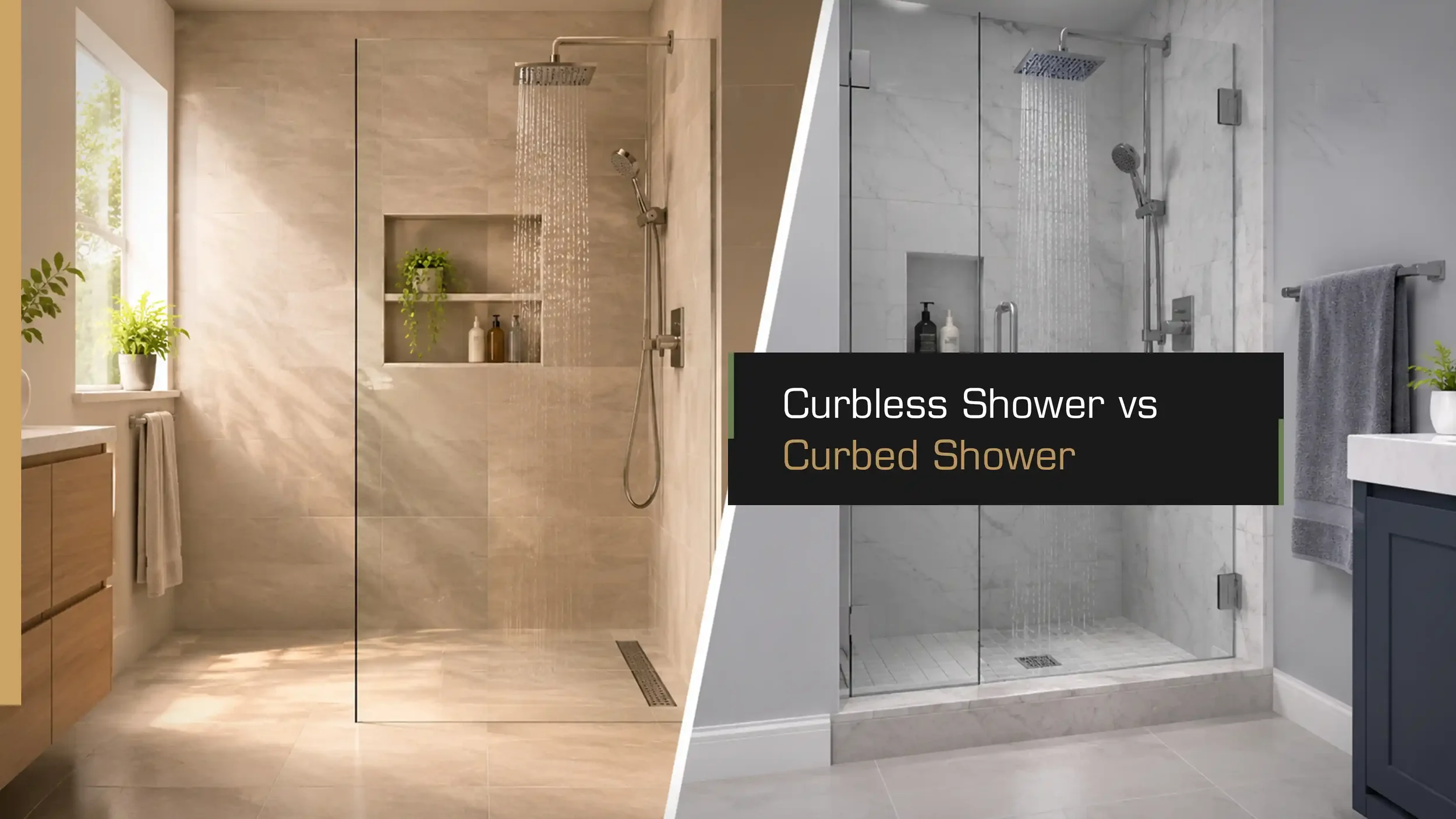
Curbless shower vs curbed shower: a curbed shower has a raised 3 to 6 inch threshold that contains water, while a curbless shower is flush with the floor and offers step-free accessibility. Curbless typically costs more due to sloped-floor and linear-drain work.
If you're mid remodel, the curbless shower vs curbed shower decision is probably one of the first forks in the road you've hit. It affects your budget, how well the shower keeps water where it belongs, whether the bathroom will still work for you in twenty years, and how much time you'll spend cleaning. Here's what a curb vs curbless shower actually looks like in practice, and how to figure out which one makes sense for your space.
What Is a Curbed Shower?
This is the shower most of us grew up with: a raised lip, typically 3 to 6 inches tall, that keeps water from wandering out onto the bathroom floor. It's been the industry default for decades, so contractors can build one with standard framing and a preformed pan, no unusual sloping or specialty drainage required. It also plays nicely with any door setup, from a basic shower curtain to a custom glass enclosure.
In a curb vs curbless shower comparison, that's the main trade-off: a curbed shower asks less of your budget and your contractor, in exchange for a step you have to clear every time you get in.
What Is a Curbless Shower?
Also called a zero entry or barrier free shower, this version skips the raised threshold entirely. The floor runs flush from the bathroom into the shower, so you can walk (or roll) straight through without stepping over anything.
Since there's no curb to physically block water, the whole system depends on a gently sloped floor and a linear drain pulling everything toward one exit point. That means more careful planning up front, often including changes to the subfloor, and waterproofing that has to be right the first time. In exchange, you get a cleaner, more open look and a shower that's genuinely accessible.
Curbless vs. Curbed: Key Differences
| Factor | Curbed Shower | Curbless Shower |
|---|---|---|
| Cost | Lower, standard install | Higher, sloped floor and linear drain |
| Water Control | Physical barrier does the work | Slope and drainage do the work, no barrier |
| Accessibility | Step over entry, tough on mobility issues | Step free, wheelchair and walker friendly |
| Maintenance | Curb traps grime, more corners | Fewer edges, easier to wipe down |
| Resale Value | Familiar to most buyers | Increasingly attractive, especially for aging-in-place buyers |
Cost & Installation
The cost of a curbless shower vs curb mostly comes down to labor. A curbed shower's preformed pan and standard framing mean most crews finish in a day or two. A curbless shower needs a sloped mortar bed (or a presloped panel system), a linear drain, and sometimes a recessed subfloor to get that flush transition right. That extra labor and material typically adds a few thousand dollars to the job, though the exact number depends on your contractor's rates and what's already going on with your floor structure. Get a written estimate from your remodeler before committing, since regional labor costs vary widely.
Water Containment & Waterproofing
With a curbed shower, the threshold does most of the heavy lifting, so waterproofing really only needs to focus on the pan and lower walls. It's forgiving: even an install that's slightly off rarely results in water actually escaping the shower.
Curbless showers don't get that safety net. Without a curb, the entire sloped floor and drain system has to be sealed correctly from day one. That's why contractors typically run a waterproof membrane across the whole floor rather than just the shower footprint, and why a flood test matters. Before any tile goes down, the drain is plugged and the pan is filled with water, usually to about 2 inches deep, then left to sit for 24 hours. If the water level hasn't dropped, the waterproofing holds. If it has, the leak gets found and fixed before it's sealed behind tile. Ask your contractor whether they perform this test; it's one of the simplest ways to confirm the work was done right.
Accessibility & Aging in Place
This is where the zero entry shower vs curbed shower decision gets serious for a lot of people. The ADA caps roll-in shower thresholds at ½ inch, and for good reason: even a low curb can block a wheelchair or catch a walker, and stepping over one is a real fall risk for older adults. A curbed shower's standard 3 to 6 inch threshold is well above that limit.
A curbless shower removes the problem outright. A wheelchair rolls straight in, a walker passes through without anyone having to lift it. It's a go-to choice for aging-in-place remodels, usually paired with grab bars and a bench seat. If accessibility is on your radar at all, even as a "someday" concern, curbless is the stronger long-term bet.
Cleaning & Maintenance
Curbed showers have more nooks, the curb itself included, where soap scum and mineral deposits like to build up, meaning more scrubbing over time. Curbless showers, with their flush floor and fewer transitions, tend to be a lot easier to keep clean, especially when paired with large format tile that cuts down on grout lines.
Resale Value & Design Flexibility
Curbed showers are the safe, expected option that most buyers immediately recognize. Curbless is gaining momentum as a modern, accessible upgrade, and it tends to appeal to a broader pool of buyers, including anyone planning ahead for aging in place. If you're in a market with an older or multigenerational buyer base, that appeal can translate into a real edge at resale.
Which Shower Is Right for Your Bathroom?
It comes down to your space and your household, not what's trending on Pinterest. A few common situations:
Tight budget or secondary bathroom: A curbed shower does the job reliably without stretching your renovation budget.
Mobility needs or aging in place: A curbless shower removes the step-over barrier entirely, worth the extra cost for the safety and independence it buys you.
Small bathroom that needs to feel bigger: The flush, open layout of a curbless shower visually opens up the room in a way a curbed one can't.
Concrete slab or shallow subfloor: A full curbless conversion might not be structurally realistic without major excavation. A low threshold curb, under an inch, splits the difference between accessibility and cost better than a standard 3 to 6 inch curb, but it's still not ADA-compliant or fully wheelchair-accessible. If true roll-in access matters, that's worth flagging to your contractor early, since it may change what's structurally possible.
Conclusion
Neither option is wrong. A curbed shower is the budget-friendly, no-surprises choice that works for most households. A curbless shower costs more up front but delivers a step-free, genuinely accessible design that can pay off down the line. Before you commit, have a remodeler assess your subfloor and layout. That's what determines what's actually feasible.
Frequently Asked Questions
-
Usually, yes. The sloped floor, linear drain, and more exacting waterproofing add labor and material costs compared to a standard curbed install, typically a few thousand dollars more depending on your contractor and existing floor structure.
-
Not if installed correctly. A properly sloped floor with a full waterproof membrane channels water to the drain just as well as a curb. A 24-hour flood test before tiling confirms the waterproofing holds.
-
Yes. The ADA limits roll-in shower thresholds to ½ inch maximum, while standard curbed showers run 3 to 6 inches, well above that. Removing the step-over barrier makes a real difference for wheelchair and walker users.
-
Often, but it depends on what's underneath. Subfloor depth and structure matter a lot. Concrete slabs or tight joist spacing can make a full conversion difficult without extra excavation.
-
A continuous waterproof membrane across the entire sloped floor, not just the shower pan, since there's no curb to catch overflow. A flood test before tiling verifies it was installed correctly.